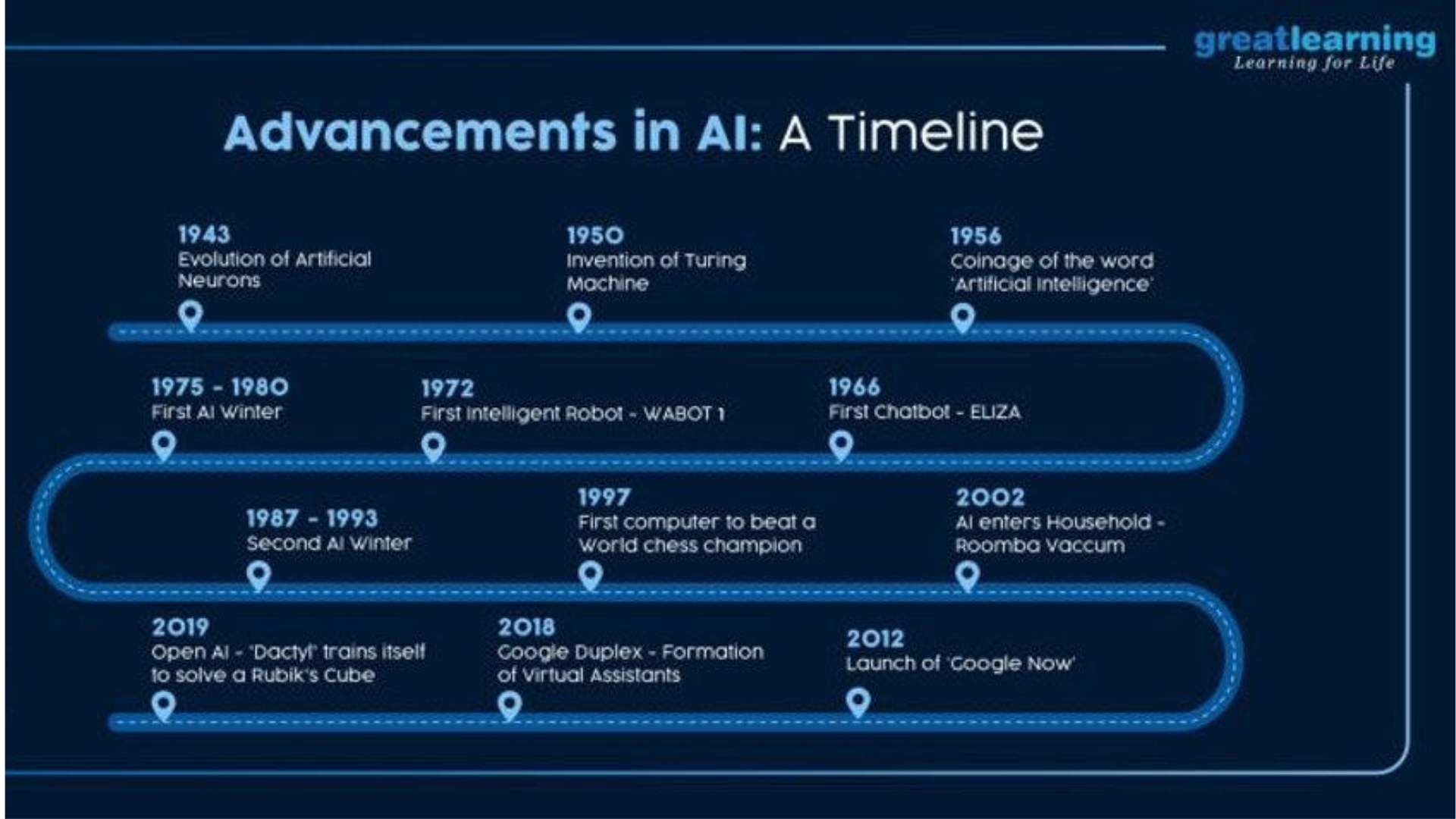
Artificial Intelligence (AI) has come a long way from its humble beginnings. Today, it powers smartphones, healthcare, education, and even entertainment. Understanding the AI evolution timeline reveals not only how far we’ve come but also what the future holds.
From early theories to advanced machine learning, AI’s story is both fascinating and full of surprises.
The Early Years: 1950s–1970s
The roots of AI began in academic and theoretical research.
-
1950: Alan Turing introduces the Turing Test, questioning if machines can think.
-
1956: The term “Artificial Intelligence” is coined at the Dartmouth Conference.
-
1960s: Early AI programs can solve simple mathematical problems and play games like chess.
-
1970s: The first “expert systems” are developed to mimic human decision-making.
These early experiments laid the foundation for modern AI technology.
The Rise of Machine Learning: 1980s–1990s
AI begins learning from data, rather than following rigid instructions.
-
1980s: Neural networks start gaining attention.
-
1987: The first AI winter begins due to high expectations and limited computing power.
-
1990s: Machine learning algorithms improve, allowing AI to perform pattern recognition.
During this period, AI moved from theory to practical applications in industries like finance and manufacturing.
AI Breakthroughs: 2000–2010
The 21st century brought rapid AI progress, powered by data and computing advances.
-
2000: AI starts powering recommendation systems on websites and streaming platforms.
-
2005: Self-driving car experiments begin.
-
2006: Deep learning emerges, enabling AI to process images, speech, and language more effectively.
-
2010: AI becomes more integrated into mobile devices and online services.
This period marked the start of AI’s presence in everyday life.
Modern AI: 2010–2025
AI technology has exploded in capabilities and applications.
-
2011: IBM Watson wins Jeopardy!, showcasing AI’s natural language understanding.
-
2012: Google’s neural networks start recognizing cats in YouTube videos automatically.
-
2015: AI assistants like Siri, Alexa, and Google Assistant gain popularity.
-
2016: AlphaGo defeats human Go champion, demonstrating advanced strategic thinking.
-
2020: GPT models show AI’s ability to generate human-like text.
AI is now a critical part of healthcare, business, education, and entertainment.
AI in Everyday Life: 2025–2030 (Predicted)
The AI evolution timeline continues into the near future.
-
AI assistants will anticipate your needs before you ask.
-
Self-driving cars will dominate cities.
-
AI-powered healthcare will diagnose and treat diseases faster than ever.
-
Smart homes will operate autonomously, managing energy, groceries, and security.
These predictions show that AI will soon be an invisible but essential part of daily life.
AI in Advanced Industries: 2030–2040 (Predicted)
The next decade promises unprecedented AI breakthroughs.
-
AI in space exploration and climate modeling
-
Autonomous industries powered entirely by AI
-
AI-driven creativity in art, music, and entertainment
-
Predictive AI for global resource management
The AI evolution timeline highlights how AI will reshape the world on a global scale.
Key Milestones in AI Evolution Timeline
| Year | Milestone | Impact |
|---|---|---|
| 1950 | Turing Test | Foundation of AI thinking |
| 1956 | Dartmouth Conference | Term “Artificial Intelligence” coined |
| 1966 | ELIZA chatbot | Early natural language processing |
| 1980 | Expert systems | AI mimics decision-making |
| 1997 | Deep Blue beats Kasparov | AI excels in strategy games |
| 2011 | IBM Watson wins Jeopardy! | Advanced reasoning & NLP |
| 2016 | AlphaGo defeats Go champion | AI learns complex strategies |
| 2020 | GPT models released | AI generates human-like text |
| 2025 | Predicted AI in smart cities | AI integrated in daily life |
| 2030 | Predicted autonomous industries | AI transforms global economy |
Ethical and Social Implications of AI Evolution
AI’s evolution is not without challenges:
-
Job displacement as automation grows
-
Privacy concerns with data-driven AI
-
Bias and fairness issues in AI decision-making
-
Over-reliance on AI, reducing human critical thinking
Understanding AI’s history helps us anticipate and address these challenges responsibly.
Frequently Asked Questions (FAQs)
What is the AI evolution timeline?
It is a chronological overview of AI’s development from early experiments to modern applications and future predictions.
When did AI become mainstream?
AI started impacting daily life significantly around 2010 with smartphones, AI assistants, and online services.
How will AI evolve in the next decade?
AI will dominate healthcare, transportation, smart cities, creativity, and business automation.
Is AI safe for the future?
Yes, with proper regulation, ethical guidelines, and human oversight, AI can be a powerful tool for progress.
Final Thoughts
The AI evolution timeline shows a remarkable journey from theory to reality. AI has already transformed industries, daily life, and human creativity — and the future promises even greater change.
Understanding this timeline allows us to embrace AI responsibly and prepare for a world where artificial intelligence is an integral part of reality.
Leave a Reply