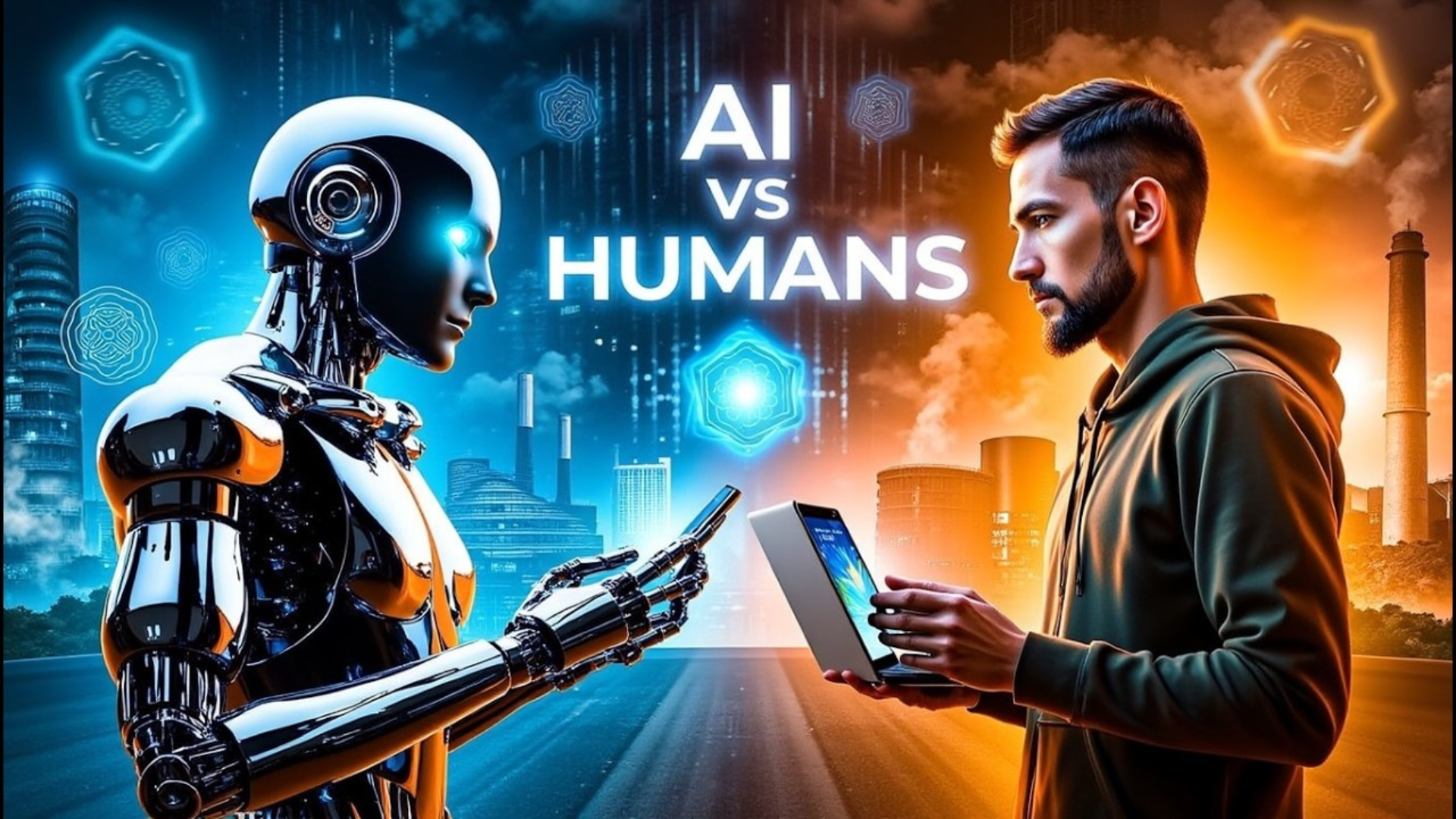
Artificial intelligence is no longer just improving existing tools or automating routine tasks. A profound shift is underway—AI is now discovering technologies that human minds never consciously designed, predicted, or even imagined.
What once sounded like science fiction is becoming scientific reality. From uncovering new physical materials to proposing radical energy systems and designing novel computing architectures, AI is stepping into a role humanity has never witnessed before: a discoverer of the unknown.
This article explores how AI is doing this, why it matters, and what it means for the future of civilization.
The Shift from Human Innovation to AI Discovery
For centuries, technological progress followed a predictable pattern:
-
Humans asked questions
-
Humans formed hypotheses
-
Humans designed tools to test them
AI changed that cycle.
Modern AI systems don’t merely follow human intuition. They analyze patterns at scales beyond human cognitive limits, discovering relationships that were invisible to us. In many cases, scientists don’t fully understand why an AI-generated solution works—only that it does.
This marks the transition from:
Human-led invention → AI-led discovery
How AI Discovers the “Unimaginable”
AI Thinks Outside Human Bias
Human thinking is constrained by experience, culture, and historical knowledge. AI has none of those limitations.
It doesn’t assume:
-
What is “possible”
-
What is “efficient”
-
What has “never worked before”
As a result, AI often proposes solutions that look wrong to humans—until they are tested and proven right.
Searching Vast Possibility Spaces
Some technological problems have trillions of possible combinations. Humans can test only a fraction.
AI systems can:
-
Simulate millions of scenarios
-
Test impossible-to-manually-check combinations
-
Optimize designs without intuition
This is how AI is now discovering:
-
New molecular structures
-
Unknown material properties
-
Novel engineering configurations
Emergent Intelligence and Unexpected Solutions
One of the most surprising developments is emergent behavior—AI systems producing outputs that were never explicitly programmed.
In simple terms:
AI is discovering new ideas as a byproduct of optimization.
This is not creativity in the human sense—but it is innovation without precedent.
Real Areas Where AI Is Discovering New Technologies
AI-Discovered Materials
AI has already proposed materials that:
-
Are stronger than steel but lighter than plastic
-
Conduct electricity in unconventional ways
-
Exhibit properties never observed in nature
In some cases, these materials were so counterintuitive that scientists initially dismissed them—until experiments confirmed the results.
This is accelerating:
-
Aerospace engineering
-
Battery technology
-
Semiconductor development
AI Discovering New Physics Models
AI systems analyzing particle physics and cosmology data have suggested alternative models of physical behavior—some of which don’t align with classical equations.
Instead of replacing physics, AI is:
-
Highlighting gaps in existing theories
-
Proposing mathematical relationships humans overlooked
This could lead to breakthroughs in:
-
Energy generation
-
Space propulsion
-
Fundamental physics itself
AI Designing Machines Humans Can’t Conceptualize
In engineering simulations, AI-designed components often look:
-
Asymmetrical
-
Organic
-
Almost “alien”
Yet these designs outperform traditional human-engineered ones.
Examples include:
-
Aircraft components
-
Heat exchangers
-
Structural supports
Humans struggle to explain why they work—but they do.
AI Creating New Forms of Computation
Beyond classical and quantum computing, AI is exploring:
-
Hybrid computational models
-
Neuromorphic architectures inspired by biology
-
Self-optimizing hardware designs
Some of these systems challenge our very definition of what a “computer” is.
Technologies That Don’t Exist Yet—but AI Is Predicting
One of the most powerful applications of AI is predictive discovery.
By analyzing long-term data trends, AI is forecasting technologies that:
-
Are not yet buildable
-
Have no prototypes
-
Lack human conceptual frameworks
Examples include:
-
Self-evolving energy grids
-
Autonomous scientific laboratories
-
Adaptive infrastructure that redesigns itself
These are not products—they are technological directions.
Why Humans Would Never Imagine These Technologies
There are three key reasons:
-
Cognitive Limits
Human brains evolved for survival, not multidimensional optimization. -
Historical Anchoring
We extrapolate from what already exists. AI does not. -
Risk Aversion
Humans dismiss ideas that feel “too strange.” AI explores them anyway.
AI does not fear being wrong—and that changes everything.
The Role of Humans in an AI-Discovery World
Despite these breakthroughs, AI is not replacing humans. Instead, roles are shifting.
Humans Still Control:
-
Goals
-
Ethics
-
Interpretation
-
Application
AI may discover technologies, but humans decide what to build, deploy, and regulate.
The future belongs to:
Human–AI collaboration, not competition
Risks and Ethical Questions
AI discovering unknown technologies raises serious concerns:
-
What if AI discovers dangerous systems before safeguards exist?
-
Who owns AI-generated discoveries?
-
How do we regulate technologies humans don’t fully understand?
These questions are now urgent—not hypothetical.
Responsible governance will be as important as innovation itself.
Is This the Beginning of a New Technological Era?
Many experts believe we are entering a post-invention era, where:
-
AI proposes
-
Humans evaluate
-
Civilization evolves faster than ever before
This doesn’t mean the end of human creativity—it means amplification beyond imagination.
What the Next 10–20 Years May Look Like
By 2035–2045, we may see:
-
AI-led scientific discoveries as the norm
-
Entire industries built on AI-originated concepts
-
Technologies that feel more “grown” than designed
History will likely mark this period as:
The moment intelligence stopped being exclusively human
Final Thoughts
AI discovering technologies humans haven’t imagined yet is not a distant future—it’s already happening.
We are witnessing the emergence of a new kind of discovery:
-
Faster than human thought
-
Unbound by intuition
-
Capable of reshaping reality itself
The challenge now is not whether AI can imagine the future—but whether humanity is ready to understand and guide it.
Frequently Asked Questions
How is AI discovering technologies humans haven’t imagined?
AI analyzes massive datasets, simulations, and complex systems far beyond human cognitive limits. By exploring combinations and patterns humans would never test manually, AI uncovers solutions and technologies that were not part of human intuition or traditional thinking.
Is AI really inventing new technologies or just improving existing ones?
AI is doing both. While it improves current technologies, it is also proposing entirely new designs, materials, and models that humans did not previously conceptualize, especially in physics, materials science, and engineering.
Can humans understand the technologies discovered by AI?
Not always immediately. In many cases, AI-generated discoveries work in practice, but scientists struggle to explain why they work. Human understanding often comes later through research and experimentation.
What industries are most affected by AI-driven discovery?
Industries seeing the biggest impact include healthcare, aerospace, energy, materials science, computing, pharmaceuticals, and climate technology. These fields benefit most from AI’s ability to explore vast possibility spaces.
Does AI discovering new technologies mean humans will become obsolete?
No. Humans remain essential for setting goals, applying ethics, interpreting results, and deciding how technologies are used. AI discovers possibilities, but humans guide purpose and responsibility.
Are AI-discovered technologies safe to use?
Safety depends on human oversight. AI can discover powerful technologies, but without regulation, testing, and ethical frameworks, some discoveries could pose risks. Responsible governance is critical.
Can AI discover new laws of physics?
AI can identify patterns and propose models that suggest gaps or alternatives to existing physics theories. While it doesn’t “prove” new laws on its own, it helps scientists uncover possibilities that lead to breakthroughs.
Who owns technologies discovered by artificial intelligence?
Ownership is still a legal gray area. In most cases, the organization or researchers using the AI claim ownership, but global laws are evolving as AI-generated discovery becomes more common.
Will AI eventually design technologies without human involvement?
AI may autonomously design systems, but human involvement will remain necessary for approval, deployment, and ethical decision-making. Fully independent AI technology deployment is unlikely without regulation.
What does this mean for the future of innovation?
It signals a shift toward a new innovation era where AI accelerates discovery while humans focus on meaning, impact, and direction. Innovation will become faster, deeper, and more transformative than ever before.
Leave a Reply